| |
Hail Atlantis,
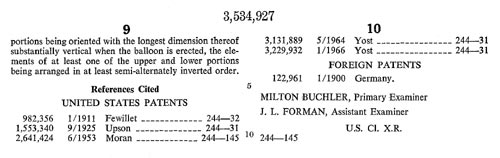
Charlie Brown, and Linden Harding's 1970 balloon
patent
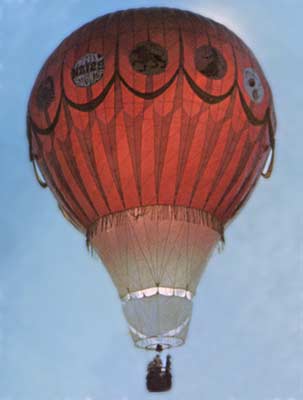
Michigan designer Linden F.
Harding took a fresh approach
to balloon design. So what ever became of Harding
and his "Transcom" balloons? Now we know - read
on!
Since putting this page up,
I've been contacted by a couple of people who knew Linden Harding
back in his early balloon-building days. One of them tracked Mr.
Harding down, and, a short time later, I received a delightful
e-mail from Mr. Harding himself. Click
here for Linden Harding's own description of how he, and the
state of Michigan, got started in hot-air ballooning.
|
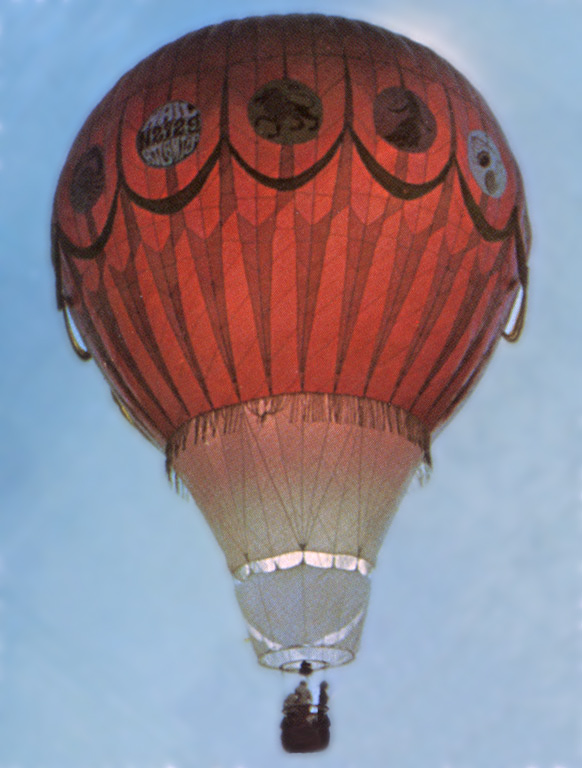
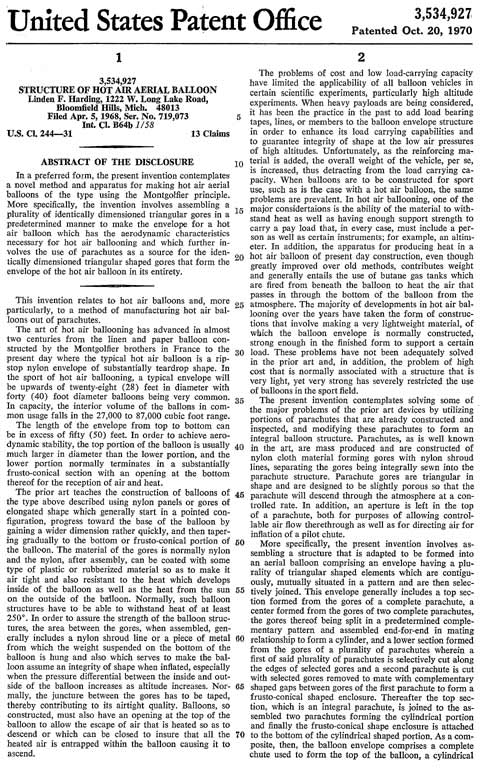
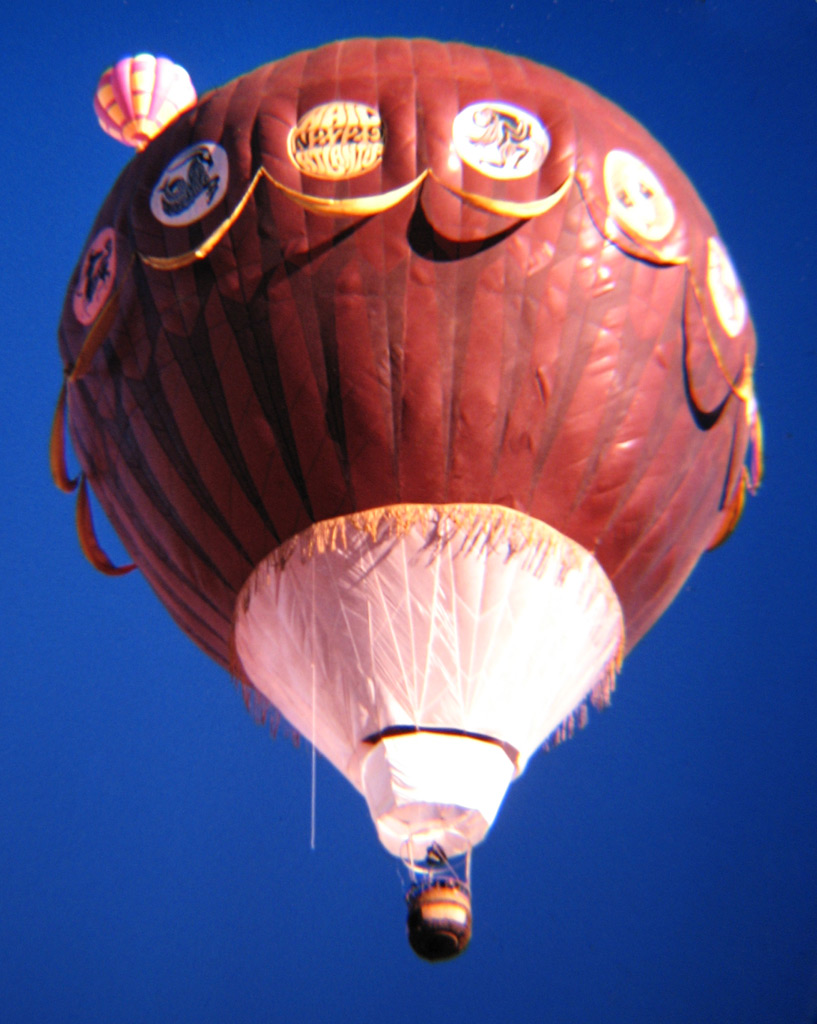
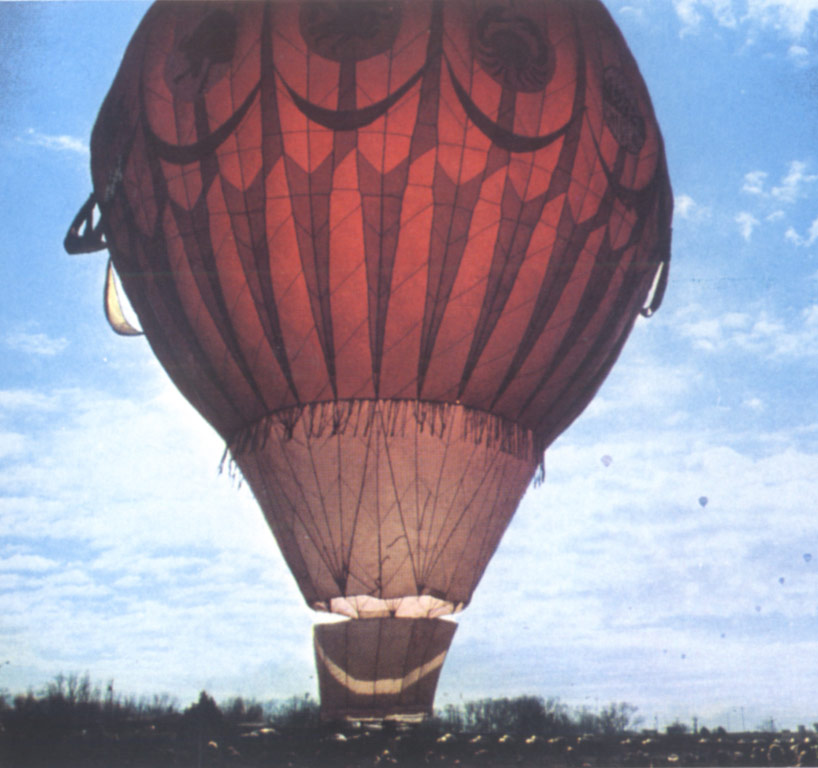
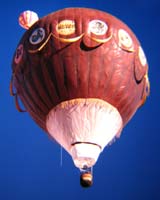
The balloon pictured above is one of the most
innovative of the early American homebuilts. When I found the
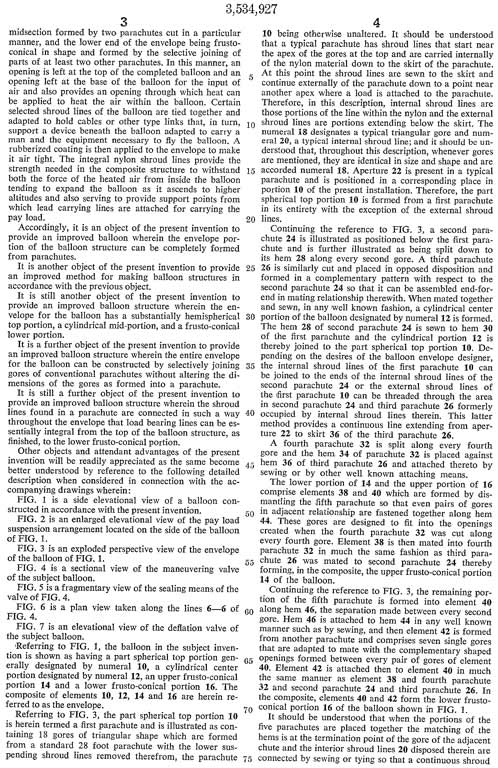
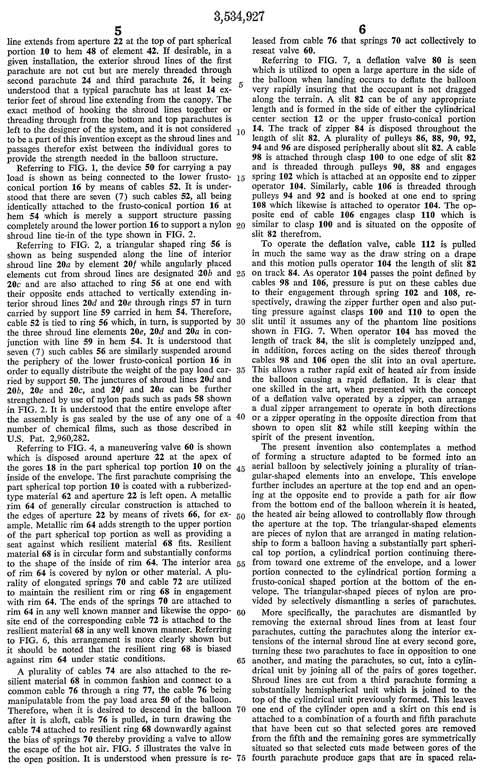
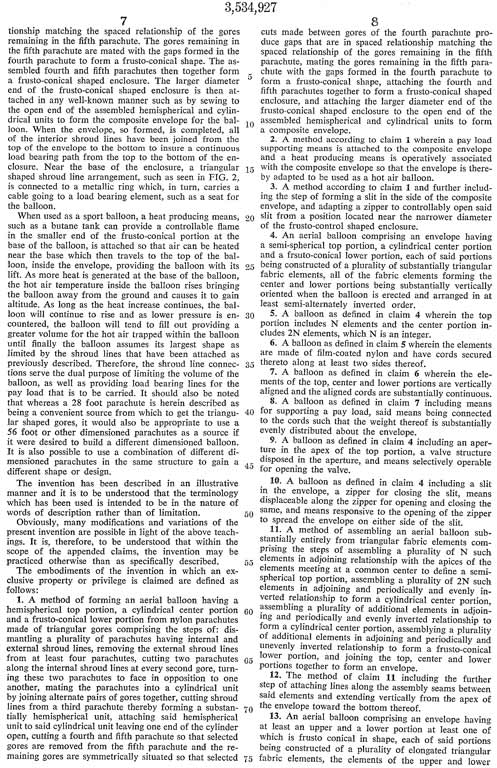
patent held by its designer, I thought I'd found what amounted to
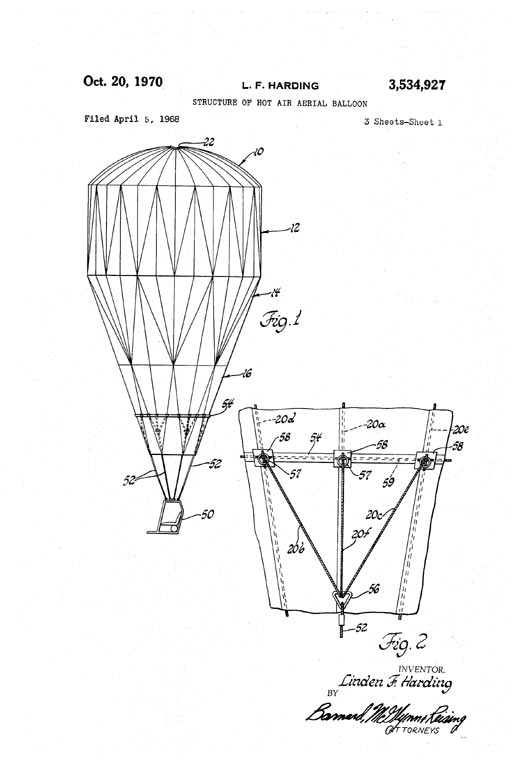
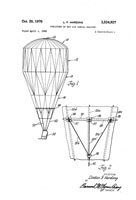
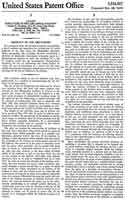
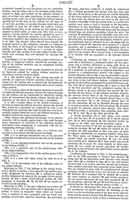
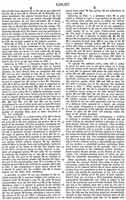
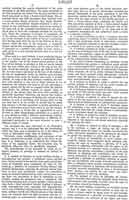
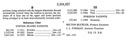
the plans for this balloon. I hadn't. The patent documents describe
a balloon called Charlie Brown, a one-place balloon with a
dragster seat for the pilot. The balloon in the photos is Hail
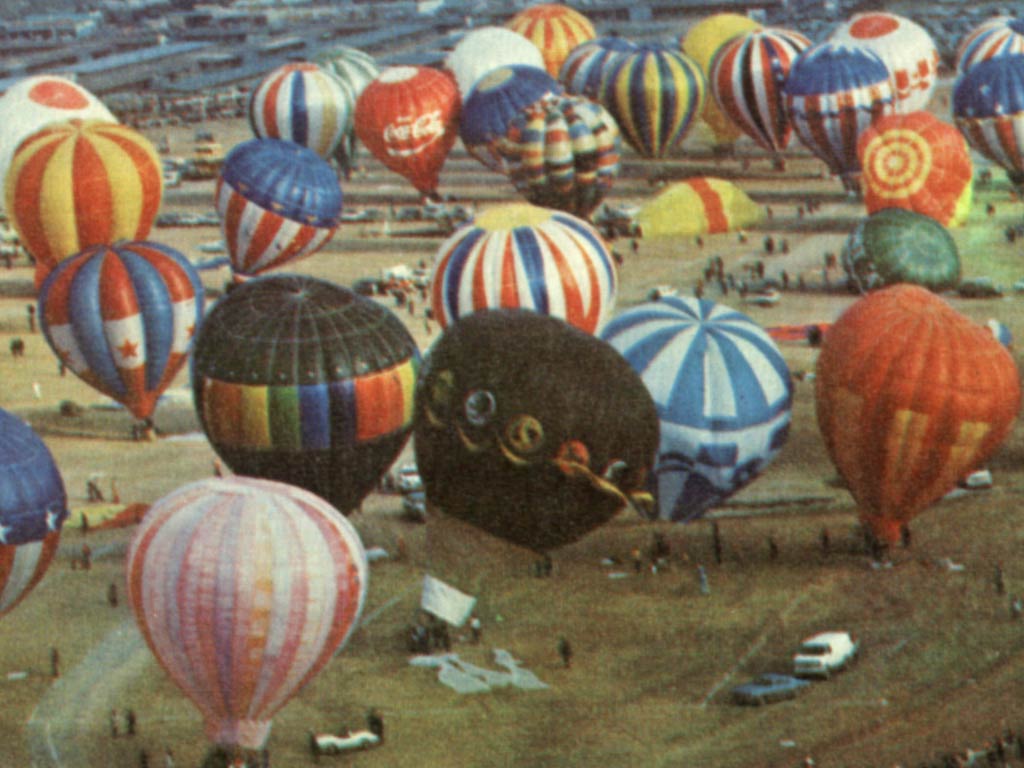
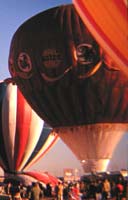
Atlantis, built in the late 1960s and entered in the 1973 and
'74 Fiestas as a "Transcom-Commodore" (but registered as a
homebuilt). She was the brainchild of Linden Harding, a talented
automotive designer at General Motors' Tech Center in Warren,
Michigan. One writer recalls that Harding penned the form of the
original Trans-Am Firebird (including the bird design on the hood),
as well as the long-nose Cadillac Eldorado and the distinctive
split-window Buick Riviera. Harding was assisted in the design and
construction of Hail Atlantis by a team of young graduates
and engineering students from GMI (General Motors Institute, in
Flint, Michigan), who aided in all phases of Hail Atlantis'
creation, including the complex mathematical formulas determining
the size and shape of each fabric panel.
Harding ordered the woven basket from Poland -- it was both
spacious and, as proven in several hard landings, durable. Both
Hail Atlantis and Charlie Brown were constructed from
surplus Navy parachutes (Harding was a Navy reservist, hence
Charlie Brown's orange-and-white color scheme). The
parachutes were laboriously disassembled stitch-by-stitch, cut to
shape, numbered, and coated with a costly clear, rubberized
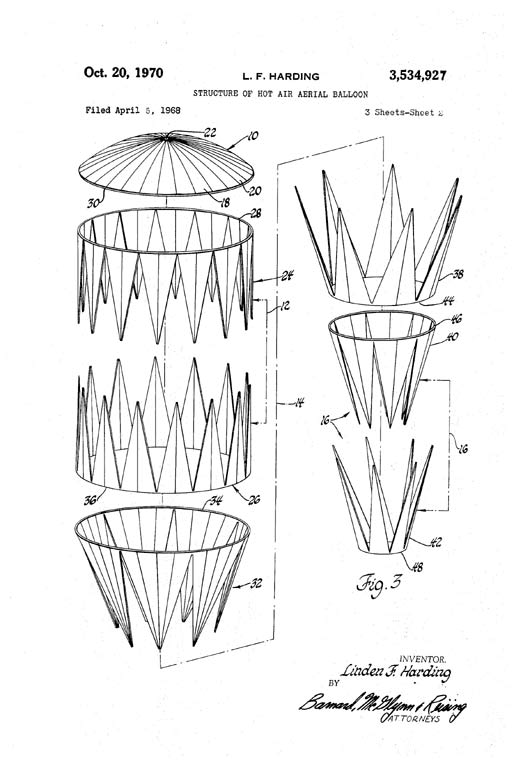
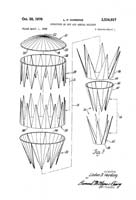
coating. The panels were then re-cut and assembled into the pattern
of nested triangles depicted in the Charlie Brown patent
documents. One visitor recalls that the burner unit consisted of
three separate modules.
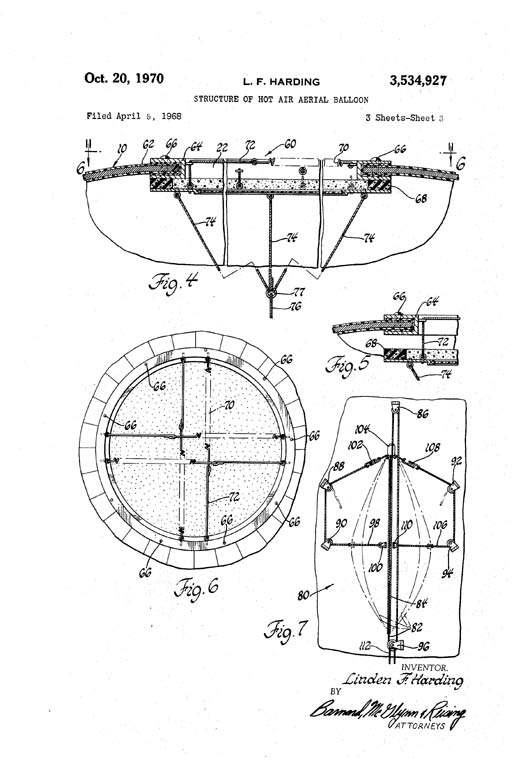
The envelope incorporated vertical metal cables for strength (and,
one would assume, conductivity, although this was fortunately never
tested). Harding flew with no instruments, although he did use
handheld radios of spotty reliability. Occasionally, a local
constabulary would go so far as to arrest Harding and his
passengers when their appearance from above caused undue commotion
among the gentry.
Harding formed the "Balloon Platoon of America," a successful
balloon club whose fast growth paced the exploding popularity of
ballooning in the early 1970s. Occasionally, Harding and Hail
Atlantis would be retained for appearances at public events in
Michigan, Ohio and Pennsylvania (generally shopping-center
promotions). For a time, Hail Atlantis was acknowledged to
be the largest hot-air balloon in the world.
Interestingly, there's an entry in the 1974 Fiesta program for one
Michael Kemeter of Dexter, Michigan, flying Echo, a Transcom
AX-7. It's one of the few entries in that program without a photo
of the balloon. Obviously, I know nothing whatsoever about
Echo. Do you?
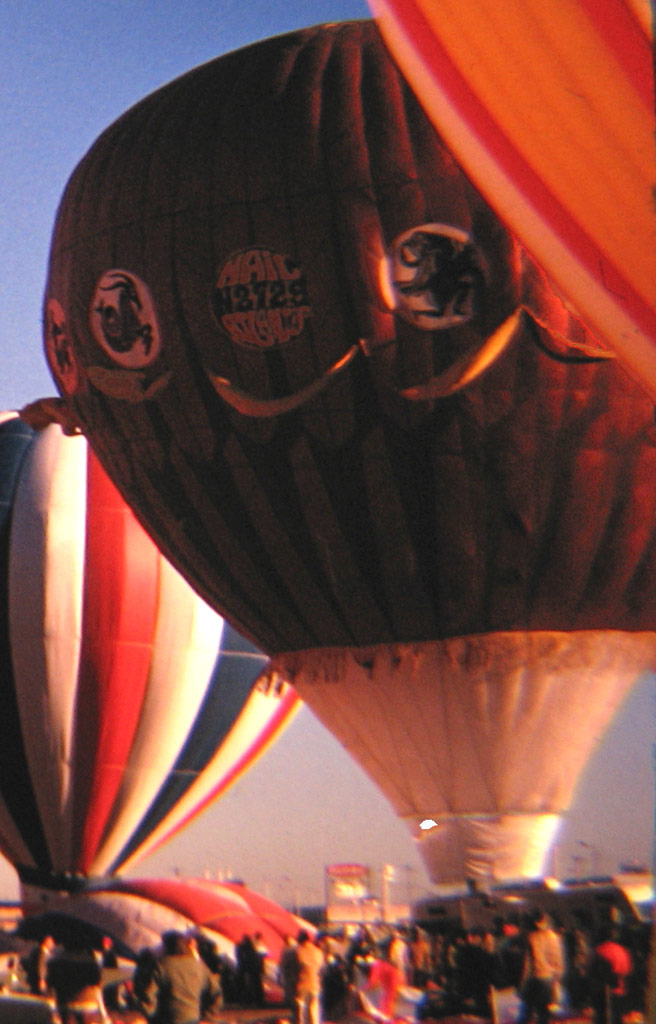
I hope to collect more images of Hail Atlantis (and,
ideally, some of Echo and/or Charlie Brown), but at
present, the photo above is the best shot I have of her basket and
burner. I've always considered this the balloon I'm most eager to
learn about - a highly unusual design about which mysteriously
little is known. I'm grateful, then, to those who have written with
information on Harding and his balloons. If you have information on
either subject, and especially if you have photos of Hail
Atlantis or (dare I ask) Charlie Brown, I'd really
appreciate it if you'd drop me a
line.
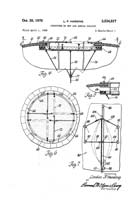
For now, thanks to the U.S. Patent Office, I can present all you could ever want
to know about the unique envelope design conceived for Charlie
Brown and adapted for Hail Atlantis. Scroll down to view
the Charlie Brown patent files and images of Hail
Atlantis, and read more about Harding and his
creations.
|
As always on these pages, clicking on an image (including the one
above) will open a new window with a much larger version of the
image.
You can also download a .zip archive containing the patent
documents from the U.S.
Patent Office in .tiff format (Click here).
 |
 |
 |
 |
 |
 |
 |
 |
|
|
|
|
 |
A few more images of
Hail Atlantis...
|
 |
 |
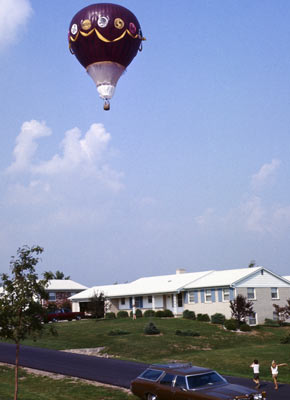
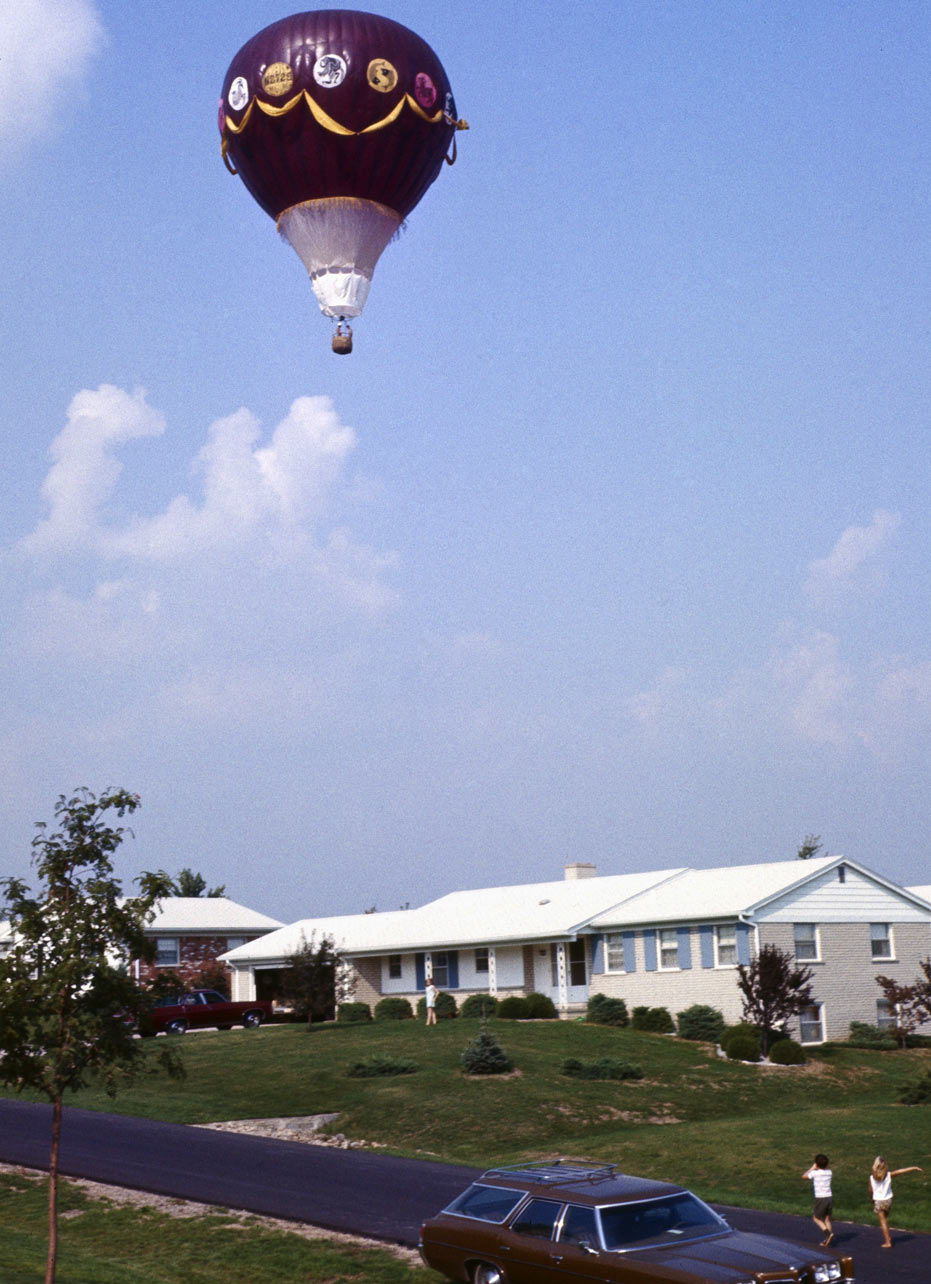
Hail Atlantis over Sandstone Drive, Tienken Manor, Rochester, Mich., around 1972
Photo: George Schutte; courtesy Patrick Schutte
Thank you, Patrick, for my favorite Hail Atlantis photo!
|
 |
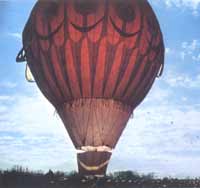 |
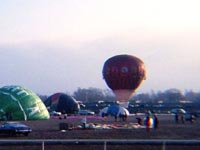
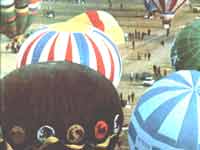
Photo by the author's Mom
|
 |
READERS WRITE!
Jeff Kocher sent this e-mail about Linden ("Lin") Harding and
his balloons, which I adapt here, with Jeff's kind permission:
Glad to see Hail Atlantis on your
site! My father helped Lin build his first balloon, Charlie
Brown and Hail Atlantis as part of Lin's "Balloon
Platoon," formed when they both worked at the GM Tech Center in
Warren, Michigan. I first saw Charlie Brown at a photo shoot
on the Tech Center grounds as a young child. Of course, I was nuts
about anything related to aviation or spaceflight, and it was the
first aircraft I had a chance to see close-up.
Back from Michigan State University for the summer, I noticed an ad
in the local paper looking for balloon ground crew. It turned out
to be HighAmerica, the balloon ride and advertising company Lin
started when he left GM in the '70s. HighAmerica flew four Piccards
at the time -- all Stretch Sixes as I recall: Black Bart,
mostly black with orange crosses similar to the Chevy bow-tie,
Birmingham Camera, The Detroit News, and the
HighAmerica balloon. HighAmerica was blue and purple and
orange and had a white middle equipped with Velcro for banners.
Well, I began crewing as often as my regular summer job would
permit. I was a crew chief after a few weeks, and began flight
lessons in exchange for crewing. Lin taught many of the pilots in
Michigan through the '70s and '80s. I was constantly exposed to the
different pilots he trained, who continued to fly charters for him.
At the time, I believe Lin had somewhere over 1500 hours, and
constantly amazed us with what he could get a balloon to do.
Regarding the unique design in the patent - Lin never did have a
lot of capital. As I understand it, Charlie Brown was
constructed of surplus parachutes, deconstructed and reassembled as
shown in the drawings. After Hail Atlantis, I know he worked
on a perfectly smooth-sided balloon - he had photos of a test
inflation inside the Pontiac Silverdome. That balloon was destroyed
during a disastrous fire started while coating the balloon fabric.
I last talked to Lin in the mid-'90s when we brought in Don Piccard
as the speaker at the annual South East Michigan Balloon
Association (SEMBA) safety seminar.
|
|
 |